
EDUCATIONAL PRACTICE
Education is a major branch of my practice and another mode of research.
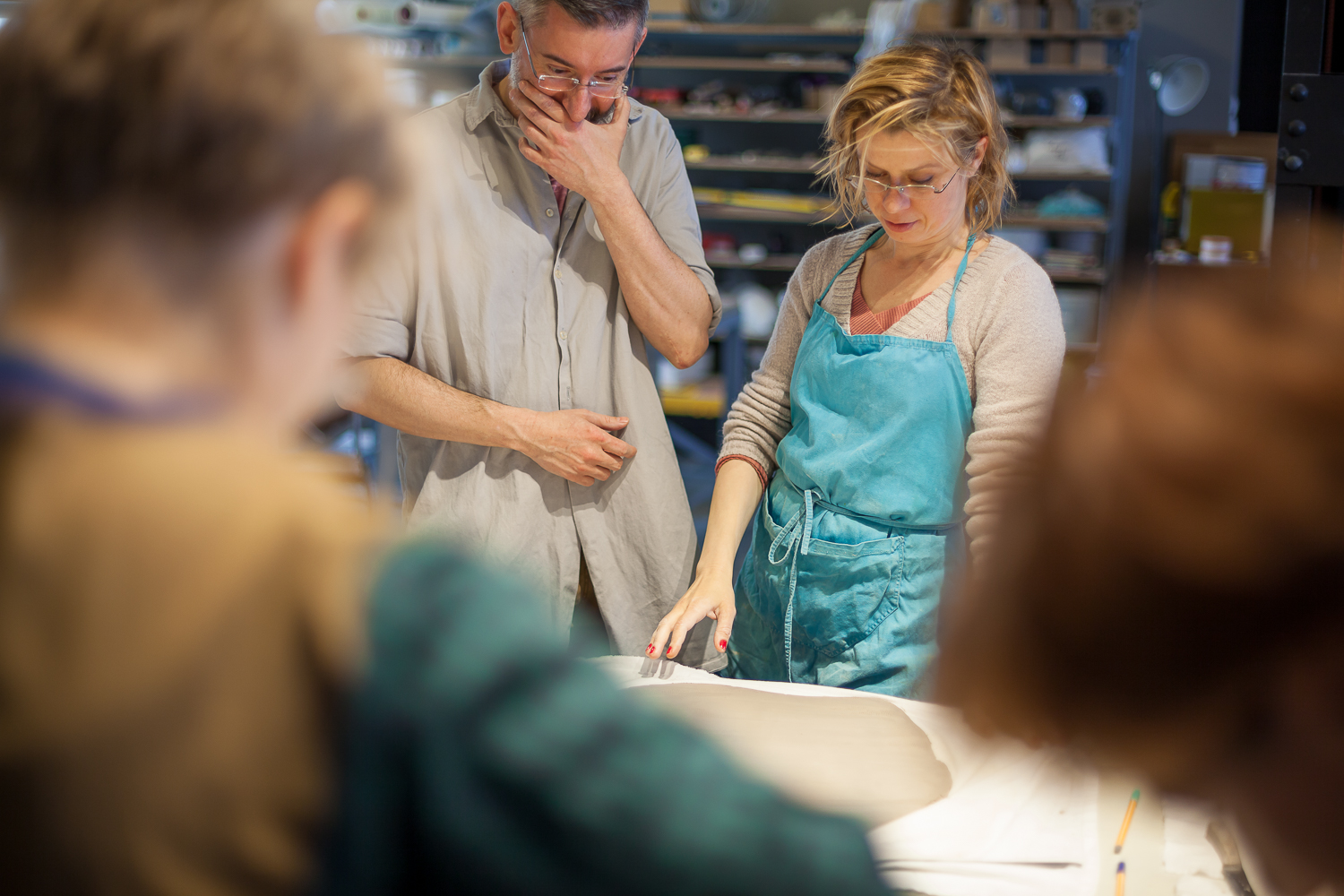
Across universities, art and architecture schools, inclusive education and cultural institutions, I develop educational programmes that function as shared investigations. Over the past two decades, I have taught participants ranging from six to eighty-five years old across Europe and Asia. While every educational context has been different, the underlying approach has remained consistent: using material investigation to develop new ways of understanding materials, environments and human relationships.
EDUCATIONAL PHILOSOPHY
My educational practice extends the same questions that drive my research. Materials become tools for observation, dialogue and experimentation, allowing technical knowledge to emerge through the process of making.
Whether working with architecture students, designers, artists, blind young people or interdisciplinary research groups, I aim to create learning environments where participants discover relationships for themselves - between materials and people, tradition and innovation, object and environment.
RESEARCH THEMES
My educational programmes repeatedly return to four interconnected areas of investigation.
Materials & Transformation
Understanding how materials change through making and how transformation can reveal new possibilities.
Perception & Making
Developing knowledge through touch, observation, experimentation and sensory experience.
COMMUNITY & PLACE
Connecting people with local materials, environments and cultural histories through collaborative investigation.
Ritual & Material Culture
Exploring how everyday practices - from shaping clay to baking bread - create meaningful relationships between people, materials and traditions.
ACADEMIC TEACHING
Shanghai Art & Design Academy, Shanghai 2016 - 2017
Faculty of Design
Semester-long design courses investigating how traditional Chinese design vocabulary can be interpreted and reimagined through contemporary material practice.
Students explored relationships between cultural heritage, material experimentation and contemporary design methodologies.
Moholy-Nagy University of Art and Design (MOME), Budapest 2009 - 2012
Architecture and Ceramic Design
Architectural Ceramic Design, Form Studies and Modelling, Form Studies in the Architecture Programme
Teaching focused on ceramics as an architectural material, spatial thinking, experimental form generation and analogue model making.
Hungarian State Institute for the Blind
Development of design courses investigating tactile urban design and furniture design.
The programme explored touch as an independent design methodology and fundamentally reshaped my own understanding of perception as a research tool.
Secondary School of Visual Arts, Békéscsaba 2005 - 2007
Teacher of Ceramic Design.
Teaching focused on ceramic design, material processes and three-dimensional form development.
PUBLIC ENGAGEMENT & KNOWLEDGE EXCHANGE
Alongside university teaching, I develop research-based educational programmes in collaboration with museums, cultural organisations, residency programmes and community initiatives.
These programmes extend ongoing investigations into public participation, connecting artistic research with environmental awareness, material culture and local knowledge through collaborative making.
RECENT INVESTIGATIONS INCLUDE:
Circular silicate materials and industrial ceramic waste
Paper porcelain and lightweight ceramic structures
Material culture, food and ritual
Tactile perception and inclusive design
Community-based environmental regeneration
Experimental material exploration across generations
Looking back, teaching has influenced my own practice just as much as my practice has influenced my teaching. Every educational context has taught me something different, and that is precisely why teaching remains an essential part of my practice.