NOBASITUS was a European collaborative research project developing new porous silicate composite materials together with modular architectural systems for urban noise reduction.
Most lightweight acoustic composites rely on organic resins or plastic-based binders that are difficult to recycle and often limit the environmental performance of the final product.
NOBASITUS investigated whether expanded perlite could instead become the basis of a fully mineral composite, using inorganic silicate binders to create recyclable architectural elements with acoustic, thermal and structural performance.
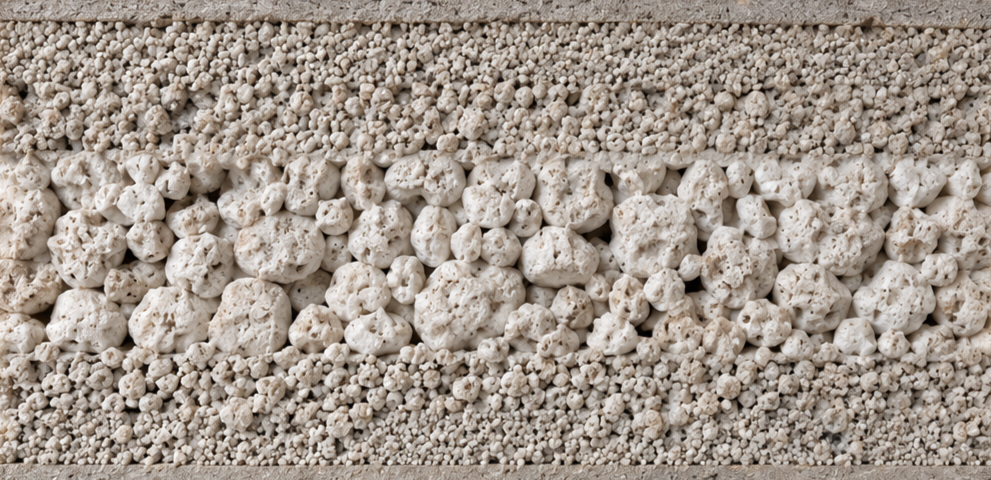
The investigation explored how different grain sizes could be organised into layered composite structures, allowing each layer to contribute distinct functional properties while remaining part of a single monolithic material.
Instead of relying on polymers or synthetic resins, the composite remained almost entirely mineral-based. The layered organisation allowed the material to combine:
high porosity where acoustic absorption was required
denser surface layers for durability and handling
lightweight construction
thermal insulation
fire resistance
recycling the material
Material composition, grain size distribution and layer sequencing became design parameters through which environmental and acoustic performance could be tuned.
Adaptive Architectural Modules
The project developed modular ceramic systems that could be configured for different architectural situations. The modules could create multidirectional sound diffusion and variable acoustic performance according to the needs of a particular site.
Environmental Urban Infrastructure
The research proposed three application areas:
roadside noise barriers
acoustic façade systems
mobile acoustic walls for temporary public events
These systems were conceived as architectural elements capable of improving environmental quality while contributing to the visual identity of cities.
2009–2010
European Commission - FP7 Research for SMEs
Collaboration
Project Coordination
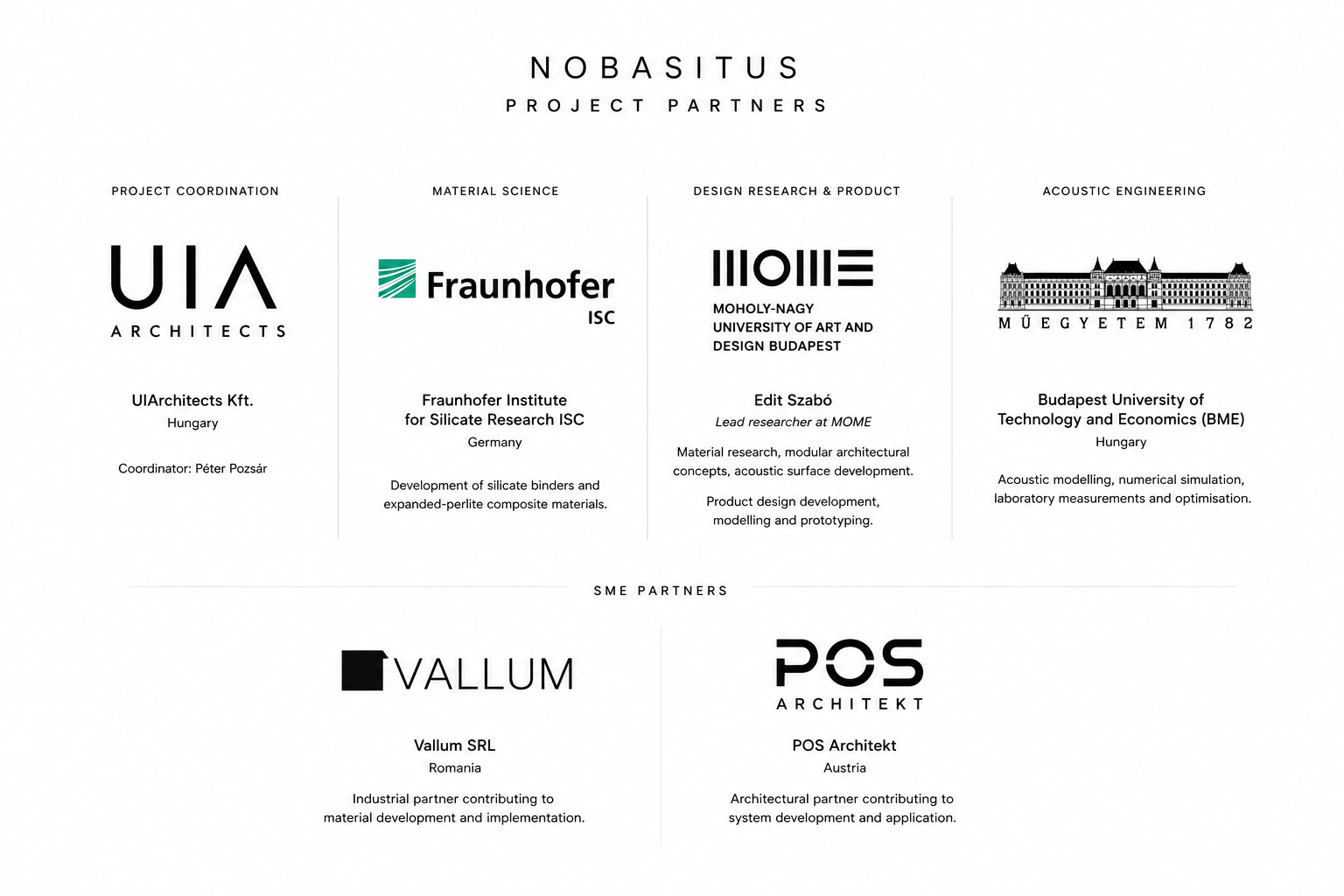
UIArchitects Kft. (Hungary)
Coordinator: Péter Pozsár
Material Science
Fraunhofer Institute for Silicate Research (Germany)
Development of silicate binders and expanded-perlite composite materials.
Design Research & Product
Moholy-Nagy University of Art and Design (MOME).
Lead researcher: Edit Szabó
Material research, modular architectural concepts, acoustic surface development, product design development, modelling and prototyping.
Acoustic Engineering
Budapest University of Technology and Economics (BME)
Acoustic modelling, numerical simulation, laboratory measurements and optimisation.
SME Partners
Vallum SRL (Romania)
POS Architekt (Austria)
Sustainable Acoustic Material
Development of porous expanded-perlite composites with new silicate binders capable of combining:
sound absorption
thermal insulation
durability
frost resistance
recyclability
low environmental impact
The material itself became an active environmental component rather than a passive construction product.